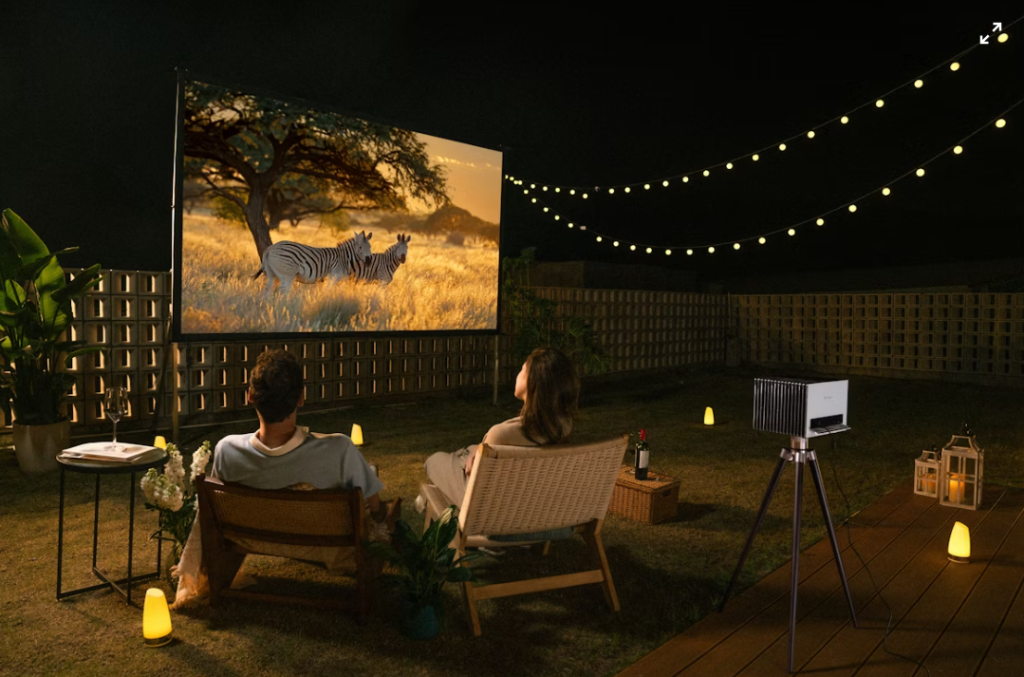
For the true cinephile, building a home theater has never been simply about acquiring a “big screen.” It is a relentless pursuit of absolute visual fidelity. The ultimate goal is to replicate the director’s intent with zero compromise, ensuring that every shadow, every highlight, and every color grade is rendered exactly as it was mastered in a Hollywood post-production suite.
For years, achieving this level of cinematic realism at home required deep pockets, a dedicated, climate-controlled basement, and a willingness to constantly tinker with highly temperamental equipment. However, the high-end AV industry is currently undergoing a massive paradigm shift. The arrival and refinement of the modern 4k laser projector has completely rewritten the rules of reference-quality home cinema, rendering legacy technologies obsolete and pushing boundaries that even commercial movie theaters struggle to match.
Here is an inside look at the evolution of laser projection technology and why it has become the gold standard for luxury home entertainment.
The Bottleneck of the Bulb
To appreciate the leap forward that laser technology represents, we must first understand the limitations of what came before it. For decades, the high-end home theater market was dominated by Ultra-High Performance (UHP) lamps and xenon bulbs.
While these traditional projectors could produce beautiful images when perfectly calibrated in a pitch-black room, they possessed a fatal flaw: the light source was inherently unstable. From the exact moment a traditional projector lamp is turned on, it begins a slow, inevitable death.
Over the course of a few thousand hours, a bulb loses a significant percentage of its brightness. Worse still, as the bulb ages, the chemical composition inside shifts, causing the color temperature to drift. For a cinephile, this meant that to maintain an accurate picture, the projector required constant professional recalibration, followed eventually by expensive bulb replacements. Furthermore, these bulbs generated massive amounts of heat, necessitating loud, distracting cooling fans that ruined the quiet, tense moments of a film’s audio track.
The Solid-State Revolution: Triple Laser Engineering
The introduction of solid-state laser light engines solved the inherent instability of the bulb overnight. Instead of superheating a gas to create white light and then splitting it through a spinning color wheel, a pure laser projector generates light using distinct, highly concentrated laser diodes.
The pinnacle of this evolution is the RGB “Triple Laser” engine. In this architecture, the projector utilizes dedicated red, green, and blue lasers to generate the image directly. Because there is no color wheel and no white light being filtered down, the efficiency and purity of the light are staggering.
The practical benefits are immediate. Laser engines offer a lifespan of 25,000 hours or more with virtually zero degradation in brightness or color accuracy. A movie watched on day one will look mathematically identical to a movie watched on day one thousand. Furthermore, lasers run significantly cooler than bulbs, meaning the heavy, noisy exhaust fans are replaced by whisper-quiet thermal management systems, preserving the pristine silence of your dedicated acoustic treatments.
Unlocking the Rec. 2020 Color Space
Perhaps the most significant breakthrough of Triple Laser technology is its impact on color reproduction. In the professional film industry, color gamuts dictate the range of colors a display can physically produce. Standard televisions use the Rec. 709 or DCI-P3 color spaces, which only cover a fraction of the visible color spectrum.
Modern Triple Laser projectors are among the very few display technologies on the planet capable of reaching the BT.2020 (or Rec. 2020) color space. This is a massive, ultra-wide color gamut that encompasses vibrant, deeply saturated reds, greens, and blues that are physically impossible to replicate on standard displays or older projectors.
When you watch a 4K UHD Blu-ray mastered in HDR (High Dynamic Range), a laser engine allows you to see the hyper-realistic neon lights of a cyberpunk cityscape or the impossibly rich greens of a jungle documentary exactly as the colorist intended, completely uncompressed and vividly lifelike.
Infinite Contrast and Dynamic Range
Cinematic realism is not just about color; it is about the transition from absolute black to blinding white. Older projectors struggled with black levels because a physical bulb cannot simply turn itself off during a dark scene. It had to rely on mechanical irises to block the light, often resulting in elevated, milky gray shadows.
Because lasers are solid-state electronics, they can be modulated at the speed of light. During a scene set in deep space, the laser diodes can throttle their output down to near-zero instantly, creating inky, bottomless blacks. A fraction of a second later, they can fire at maximum intensity to render the blinding flash of an explosion. This infinite dynamic contrast breathes life into HDR content, providing a three-dimensional pop that makes the image look like a window into reality.
The Crucial Symbiosis: Engineering the Canvas
However, the optical perfection of a triple laser engine is fragile. Shooting a highly calibrated, Rec. 2020 laser beam onto a standard painted wall or a cheap, textured canvas is akin to putting low-grade fuel into a Formula 1 car. The surface will scatter the light, introduce color shifts from the wall paint, and destroy the painstaking contrast the laser just generated.
For a true cinephile setup, pairing the hardware with a reference-grade projector screen is non-negotiable. High-end screens are engineered with optical coatings that are perfectly color-neutral, ensuring zero color shift.
Furthermore, modern screens designed for laser projection feature ultra-smooth, tensioned surfaces specifically formulated to mitigate “laser speckle”—a visual artifact unique to highly coherent laser light. By using a screen engineered specifically for solid-state light engines, you preserve pixel-perfect geometry, maximum light uniformity, and the true black levels required for high-end viewing.
The Ultimate Director’s Cut
The era of compromising on image quality or dealing with the constant maintenance of high-end home cinema is officially over. The evolution of the 4K laser projector has democratized reference-level performance, bringing Hollywood-studio color accuracy, infinite contrast, and zero-maintenance reliability directly into the home. When paired with a precisely engineered projection surface, it delivers the holy grail for any movie enthusiast: pure, unadulterated cinematic realism.